Growing FREE now available for preorder

Woohoooooo!!! I am so proud to be a co-contributor to this phenomenal book. It’s filled with deep & practical wisdom about money, livelihood, building real community, and designing the life you want. Get the juicy details & reserve your copy here.

Healing ecosystems and repairing the frayed fabric of our communities will be a DIY grassroots job … and our own finances and livelihoods are a key leverage point! I am so honored and thrilled to be on this path with you guys.

Non-accumulation

In today’s world, where even just getting one’s basic needs met and bills paid can be incredibly expensive, it might seem like non-accumulation is not a feasible way of life. But that isn’t necessarily the case.

By non-accumulation I don’t mean having literally zero money, zero possessions (though some people do it this way). I just mean deliberately only keeping just the amount of stuff and money one needs, and giving any surplus back to the land and community. This can include setting limits on how much money you earn.

These numbers and values will differ from person to person, and at different times and phases of our lives. None of what I’m setting forth here (or in any of my other writings/platforms) is meant to shame anyone for having, and satisfying, wants and needs that go beyond a bare minimum. I myself have, and satisfy, wants and needs that go beyond the bare minimum. Rather, for most of us who choose it, I see non-accumulation as a path or process.

I started down this path awhile back, and felt a bit like a maverick and like I’d best stay “in the closet” about it. In a society where whole industries are dedicated to frightening or shaming people into hoarding massive amounts of stuff and money (for “retirement”; in case of illness or needing longterm care etc.), going against the current can feel dangerous. Dangerous socially and emotionally as well as materially.

But I’ve learned actually that lots of people are in fact practicing non-accumulation. So if you’re doing it or interested in looking into it, you’ve got lots of good company. I’m compiling some resources for you and will put them in the links area below.

*******

A bit of my story … (This is actually ending up being kind of long & rambling and is not even finished yet. Unless you have some extra time and patience and/or curiosity today, you might want to just go ahead and scroll right down to the Further Reading links; I’ve shared some really great stuff there!)

All of my life really, I have been doggedly determined to work at the occupations I want to work at. “Creative and occupational freedom,” I call it. This doesn’t mean I have always been able to pay the bills by only ever doing work I love. But over the years, I have reduced to a minimum, and eventually to zero, any work other than work I love / my mission in the world.

What has helped me, other than sheer stubborn diehard determination to avoid excess work, soul-sucking toil, and meaningless work, is my ability and/or willingness to ruthlessly reduce my overhead expenses. I have always found it so worth the effort.

(I need to interject here: Just about any job or any type of work can be rewarding, joyful; a ministry. What’s problematic is if we’re being pressed to do a kind of work that doesn’t align with our moral values or purpose, or being forced to work inordinately long hours just to get one’s basic needs met, or being forced to work in a toxic environment.)

And only during some relatively brief periods of my life, when I experienced deep poverty in a non-voluntary form, have I had to do without anything that really mattered to me in life. During my “involuntary deep poverty” phases, I was neglecting my health, barely keeping a roof over my head, and sometimes going hungry. Obviously that level of “doing without” wasn’t good. Despite the physical hardship, this phase taught me an immensely valuable lesson: That the worst thing about having no money wasn’t having no money per se; the worst thing was the shame: feeling like I had to hide my status from loved ones, out of fear that they would be ashamed of me and angry with me for making bad choices and squandering opportunities.

From that low point I eventually realized that I was buying into societal beliefs that were nonsense. I realized that I had not, in fact, made “bad choices” or squandered opportunities. And I was not selfish or spoiled for believing in my work and being determined to find ways to keep doing it.

OK, so to try to make a long story less long … Over the years I have come to realize I need to be more, not less, determined to stick to my moral and spiritual values. For awhile, I thought maybe compromise was the answer. It was not. I only ended up living some half-assed caricature of a “respectable middle-class person.” The source of my suffering during my “involuntary poverty” phase wasn’t not having money; it was second-guessing my lifelong sense of purpose; not believing in myself.

On the topic of self-worth and not having money: At one point around late 2011, I had literally zero money for a couple of weeks. Actually my bank balance was minus 25 cents, I think. At the same time, I had $6,000 credit-card debt (from a business venture that didn’t end up panning out but was still worth doing). My feeling at that time was, “Wow, $6,000. My entire life isn’t worth $6,000! To the world or to anyone in it! And nothing I can foresee doing will ever be worth $6,000, to the world or to anyone in it.”

This line of thinking was directly counter to one of my core spiritual beliefs, that every being has inherent worth and dignity. But I still felt how I felt.

The way I got out of that hole was (in a micro-nutshell) by relaxing my self-judgment; forgiving myself for some stuff I shouldn’t have been mad at myself for in the first place. But that’s a story for another time. To get to the center of this story I’m sharing right now, I have to backtrack a few years.

Back in 2006, I spent six months taking an extended permaculture design curriculum and internship at an eco school up in New Mexico. (I was living in Texas at the time.)

One of my favorite things about my time there was the school library, a compact treasure-house of books on all aspects of sustainable living, sustainable civilization. A lot of the stuff only existed on paper and I’ve never been able to find it online. One such reading was an essay by the school’s late founder, an anthropologist, who described her long-ago experience living among people of a South Sea island culture. What impressed me and stuck with me was how their economy worked. There was no way to store food; no banks for storing money. So, the way to be rich was by giving away your surplus. Surplus fish, whatever. The more you gave away, the richer you were in the community. People fell over themselves trying to give stuff away. There was no official system of debt, but the more you gave away, the more people felt indebted to you. You built up a “debt” of gratitude. What we in permaculture call “social capital.” It sounded really cool and amazing to me, and I wanted to live my life this way but it didn’t seem feasible in mainstream USA culture.

Since that time, I’ve learned that many traditional cultures worked pretty much that way. “I store meat in the belly of my brother,” one Amazonian tribe member told an anthropologist who asked him how/where he stored the meat he couldn’t eat right away.

Since that time, also, I have met people who, although living in the USA, are living some version of this, as I myself have come to do.

One fellow permaculturist only keeps a very small bank account of maybe a couple hundred or few hundred dollars; he constantly has his money out in his community in zero-interest micro-loans. He owns land but he shares it extensively with his communities.

Another fellow permaculturist is nomadic but always has places where people want him to come stay and teach. He earns money but gives away whatever he doesn’t need.

I myself have chosen to “own” a house, right now at least. (I bought the house in 2018 with money inherited when my Mom passed. Most of the money was in the form of mutual funds. I immediately took the money out of Wall Street and used most of it to buy my house. Most of the rest, I have invested in my business, or tithed to my community in various ways. Full disclosure, I did spend $5,000 on a brand-new Honda Rebel 300 motorcycle. I’m also a part “owner” of a permaculture farm but am not seeking any financial return on that. I have some money left over still, and feel a duty to use this money wisely and carefully — for the planet; out of respect for my parents; out of care for future generations; out of care for current generations who are struggling. Some years back, I came to a point of being adamantly against “making money off of money”; I only want to make money from my own direct work. I have a combination of hand-work and brain-work that I plan to take me into old age right up til it’s my time to die.)

The thing that makes “owning” a home work for me (spiritually, emotionally, and materially) is that I share it with other people, and have a strong intention to make a secure joyful home for people, and keep the rent low to just meet basic expenses of the house.

But: A person can have quite a huge house, and live alone, and have a lot of stuff, and still be practicing nonaccumulation; radical sharing. There’s no cookie-cutter formula.

Other things I’ve noticed that have influenced me: I personally have known several millionaires. They were more scared about money and retirement and old age and longterm care and stuff of that sort, than people I know who have no money, no health insurance, no retirement fund etc. This is not to say that people shouldn’t desire to have material comfort. build security and peace of mind; just that money doesn’t seem to give it and can sometimes even undermine it.

To be continued, more later.

Further exploration:

Sacred Economics: Chapter 19, Nonaccumulation (Pt. 20) (Charles Eisenstein; published on realitysandwich.com). “I have in this book articulated a conception of wealth as flow rather than accumulation. … Generally speaking, natural systems are
characterized by resource flow, not accumulation. … An important theme in all my work is the integration of hunter-gatherer attitudes into technological society — a completion and not a transcendence of the past. I have already laid out in this book the monetary equivalent of nonaccumulation (decayingcurrency), of nonownership (elimination of economic rents), and ofunderproduction (leisure and degrowth). Tellingly, many people feel a pull toward these values on a personal level too, such as in the movement toward ‘voluntary simplicity’ and in questioning the nature of work. Ahead of their time, these people have pioneered a new and ancient way of being that will soon become the norm. Bill Kauth, founder of the Sacred Warriors and other organizations, is an internationally known social inventor and a rich man, though not in any conventional sense. He owns very little: an old car, some personal possessions, as far as I know no financial assets. Many years ago, he tells me, he took a personal vow he calls ‘income topping,’ pledging never to earn more than $24,000 in a year. And yet, he says,’I have eaten in some of the world’s best restaurants, traveled to many of the earth’s beautiful places, had an incredibly rich life.'”

Sacred Economics: Chapter 20, Right Livelihood and Sacred Investing (Part 21). “What I am going to describe is far more radical than “socially conscious investing” or “ethical investing.” While these ideas are steps in the right direction, they harbor an internal contradiction. By seeking a positive financial return, they perpetuate the conversion of the world into money. … I am not advocating an age of altruism in which we forgo personal benefit for the common good. I foresee, rather, a fusion of personal benefit and common good. For example, when I give money to people in my community, I create feelings of gratitude that might motivate a return gift to me or an onward gift to someone else. Either way, I have strengthened the community that sustains me. When we are embedded in gift community, we naturally direct our gratitude not only towardthe proximate giver but toward the community as a whole, and we take care of its neediest members (gifts seek needs). Our desire to give may very well express itself as a gift to someone in the community who has given us nothing herself. Therefore, we can see any gift, even one without expectation of direct return, as a form of ‘investment.’ We are still taking naked money and, if it is a good investment, clothing it in something fine.”

• And here is the Sacred Economics homepage on Reality Sandwich, where Eisenstein has posted his whole book chapter by chapter.

Financial Resilience Book & Course

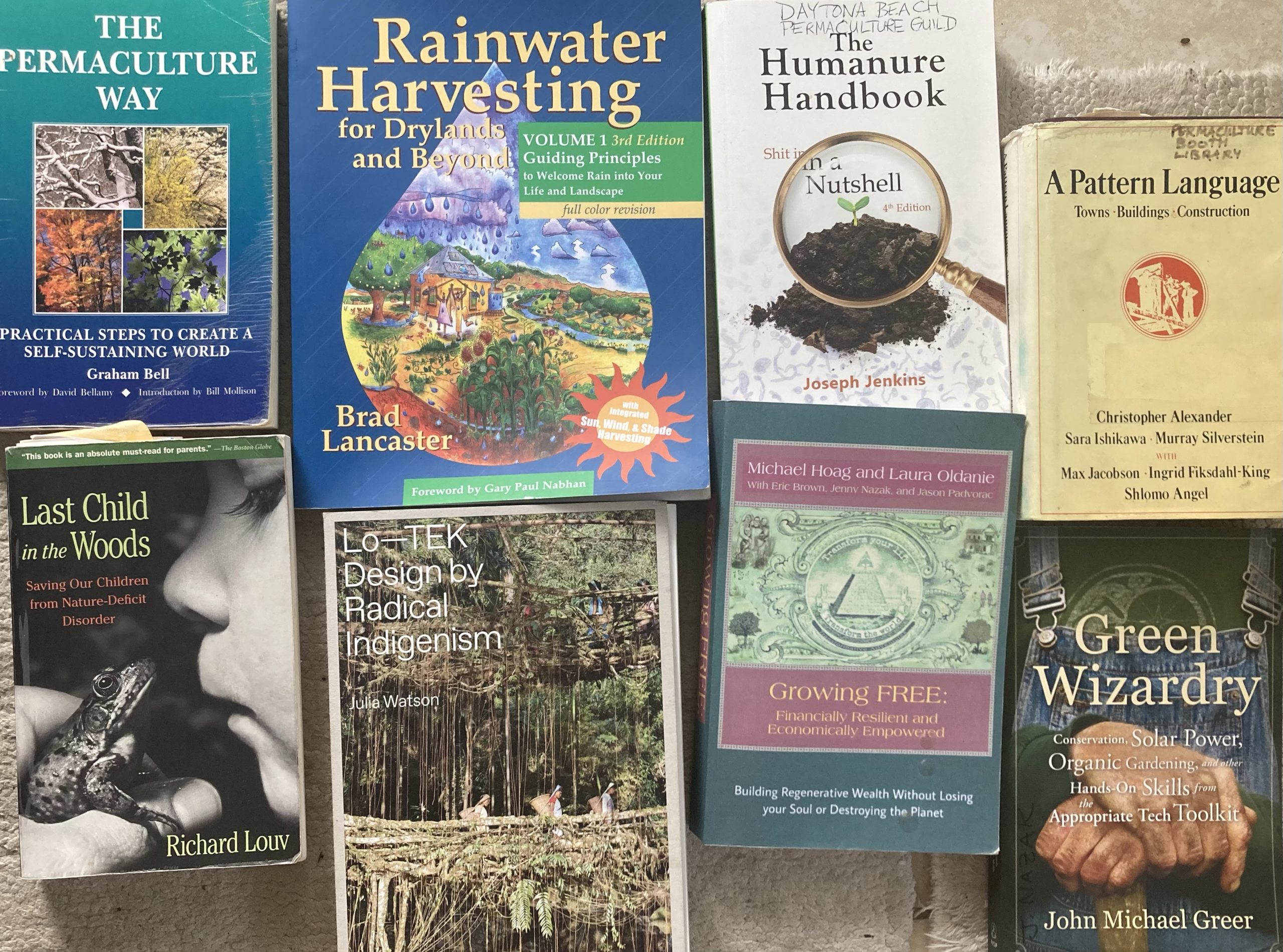
I’m very excited to be among the contributors to Growing FREE*, an upcoming book by Laura Oldanie and Michael Hoag. The book will be available at the end of November. Watch this space for updates. “FREE” stands for Financial Resilience, Economic Empowerment. We’ll be offering a course this coming winter too.

*The full title of the book is Growing FREE: Financially Resilient and Economically Empowered — Building Regenerative Wealth Without Losing Your Soul Or Destroying the Planet.

Update 10/31/22: The preorder link is now up! Go here to find out more about the book & to reserve your copy.

Pace and Rhythm

I was idly pondering the other day, about why the pace and rhythm of life are different in “northern, cold-weather” cultures vs. “southern, warm-weather” cultures (globally speaking).

(Warning: Extremely Generalized Generalizations ahead! My opinions in this post are for contemplation & discussion only, as opposed to me being a source of accurate factual details about other cultures.)

Tropical or semitropical places, the cultures tend to have a reputation for being relaxed, laid-back. Non-urgent vibe regarding work.

Places that have marked seasonal differences; winter and summer; dormant winter season … the cultures tend to have a reputation for “work work work, urgent urgent urgent” mentality.

I used to think the tropical cultures w

(to be continued — going across the street to have a glass of wine with my dear friend S.)

(The next day.) OK, I’m back!

I used to think that the tropical cultures were relax-paced because there was food growing year-round and thus no rush to harvest food and preserve it for the long winter. And possibly also because of the heat which makes rushing around impractical.

And those things may be true. But the other day, it also occurred to me that rushing around and urgency, in a place where nature exhibits year-round growth and fertility, would actually be a maladaptive trait. Because in a tropical or semitropical climate, there is always work that could be done; always something to do. Fruit to pick, vegetation to cut back; whatever. So a rush-around-oriented, “Type A” person in such a place would be very prone to burnout.

(to be continued; sipping coffee and enjoying the slant of the light on my porch and getting ready to crack some Florida-grown macadamia nuts for breakfast)

Meanwhile, in places with cold winters, the “Type A” mentality could be seen as somewhat adaptive. Rush around all spring and summer to put food by for the long winter.

In so-called “modern” consumerist society, where lights blaze 24-7 and we exist in a climate-controlled bubble year-round, it’s feasible and considered desirable to bust ass work work work, urgent urgent urgent 365 days a year; there is no winter dormancy slowdown period for us “modern” humans.

In such an artificial sub-universe as this one that we “modern, advanced” humans have co-created, it is easy to forget that in the olden days in the northern, “winter” cultures, the dark cold season, while hard, was also in many ways a period of rest — for people and for the land. The late sunrises, early sunsets, frozen ground lent themselves well to a fallow mode. Indoor projects such as mending, knitting, planning could be done, so it’s not that no work got accomplished in nature’s downtime season. It was just less hectic. Thus even in the northern cultures, people got a break from rush-rush-rush urgent-urgent-urgent. There was sitting by the fireplace; telling stories; playing music.

I think it’s no accident that some of my favorite suppliers of yarn and other knitting/crocheting materials are located in cold-winter places like Nebraska and Minnesota.

My nutshell conclusion: In cultures not infected by the relentless pace and rhythm of consumerism / capitalism, people (and the land) always got to rest, one way or the other. But in the harsh “modern economy,” colonized world, people and the land aren’t meant to rest, ever.

I see a voluntary scaled-back lifestyle (which many of us are adopting) as one way that a person (and household, community, etc.) can take back their free-agency from all this.

Further Exploration:

“Quiet Quitting” video-post on TikTok by wetheearthseed. ” … what are we giving up for these luxuries?”

15 Characteristics of White Supremacy Culture article & website by Tema Okun. This list has been such an enlightening window through which to see with fresh eyes the culture we are swimming in. I’ve had so many lightbulb moments over the past few months with the help of this list. One of the pillars of WSC is … wait for it … “sense of urgency.

• For excellent commentary and experiential clarity on the 15 pillars of WSC, also check out two of my favorite TikTok creators, desireebstephens and RoyalStarDefiant.

• UBUNTU Contributionism: A Blueprint for Human Prosperity – Michael Tellinger. Someone in one of my online groups mentioned him in passing; I have only just now started googling so I can’t comment authoritatively. But, any problematic aspects aside (such as what seems like cultural appropriation of the word ubuntu), supposedly he believes we can have a society where everyone can live well while only having to work 3 hours a week, and those 3 hours of work are done in one’s own community. Makes sense.

Sewage should not exist

Leaking septic tanks; flooding causing toilets to back up; etc. etc. …

This is extra frustrating because sewage should not exist in the first place! We should not be peeing and pooping into water!

Technologies have existed for decades (millennia actually). Even as we speak, many boaters and RVers all over the country and world (also festivals and convergences too) are using essentially waterless toilets that utilize beneficial microbes, dehydration, and other natural means to turn “waste” into pathogen-free compost.

If you are not familiar already, I encourage you to check out: #CompostToilets #Humanure @Humanure Handbook by Joseph Jenkins

Sewage should not have to exist!! Especially frustrating at a time like this when there’s excess water for the ground to absorb.

Water Stories: The Full Water Cycle; The Watershed Death Spiral

These two videos from Water Stories are under 3 minutes each. Nice animation, easy to understand the concepts; very-well-invested minutes of your time and attention.

1) The Full Water Cycle: “Most of us have been taught an over simplified story of the water cycle. The full water cycle is much more complicated and interconnected than what we learned in school. Here, we tell the whole story.”

2) The Watershed Death Spiral: “Human activity has disturbed the Full Water Cycle, resulting in the increasingly common and severe Flood, Drought, and Fire we are experiencing; as well as rising global temperatures and extreme climate. This is how we got here…”

Suggestion: Forward the text of this post, or even just the video links, to your city commissioners, public-works department, and anyone else who works on the frontlines of water issues in your community and region. Also post in your eco groups on social media. We need to get this awareness out there!

A huge Thank You to Water Stories for making the job of us ecosocial activist/educators a lot easier with their videos and webinars and other content.

Speaking of which, Water Stories has a “Permaculture Water Summit” coming up today and tomorrow, and there may still be spaces open. The summit is online and it’s free to attend.

Sorry for the last-minute notice! Good news though: Water Stories has a major course coming up in January. It’s called the “Water Stories Core Course” and is for people who are or who seek to become water-restoration practitioners, land stewards, and water advocates. Visit the link to sign up for the waitlist.

And here’s the front page of the Water Stories website, where you can sign up for their email newsletter and get more timely updates of their doings.

Modern Isn’t Necessarily Better

“Modern” is not always better than old. “Modern” can be very fragile in addition to being high-maintenance, expensive, and bad for people & ecosystems. Example: Asphalt roads need constant maintenance, while some dirt roads have been in continuous use for decades or even centuries with minimal to no maintenance.

Further exploration:

• Google “vine bridges”; “rope bridges”; “living bridges”

• Book: Lo-TEK Design by Radical Indigenism, by Julia Watson. “TEK” stands for Traditional Ecological Knowledge.